
last updated: September 16, 2025
The source field—continuing from the root context defined by the Main (Event) JSON Path—specifies how to retrieve the desired data from the ingested payload. Because the payload is a JSON structure, it is useful to understand the types of JSONPath expressions that can be used for the source field.
Supported JSONPath Expressions for the Source Field
|
Categories |
Examples |
Notes |
|---|---|---|
|
Each segment accesses a field nested within the previous one. |
|
|
– |
|
|
– |
|
|
Extracts all matching fields located at different nesting levels.
|
|
|
Evaluates each item from the immediately preceding path step—whether from an array or object—against the condition inside |
Worked Examples
JSON Payload
{
    "results": [
        {
            "url": "https://example.com/api/v2/organizations/133.json",
            "id": 133,
            "name": "org 133",
            "shared_tickets": false,
            "shared_comments": false,
            "external_id": null,
            "created_at": "2025-12-05T10:15:30Z",
            "updated_at": "2025-12-05T18:45:00Z",
            "domain_names": [
                "org domain 13",
                "org domain 3",
                "org domain 133"
            ],
            "details": "details 133",
            "notes": "notes 133",
            "group_id": 133,
            "tags": [
                "tag 13",
                "tag 3",
                "tag 133"
            ],
            "organization_fields": {
                "country": "canada",
                "org_type": "cybersecurity",
                "status": "established"
            },
            "result_type": "organization",
            "demo_key": {
                "layer2": {
                    "layer3": {
                        "layer4": {
                            "layer5": {
                                "target": "demo value 133"
                            }
                        }
                    }
                }
            }
        }
    ]
}
READER NOTE
Update the payload's id field in the following examples with a unique value prior to each webhook push test.
Example 1 - Dot Notation
Objective – Demonstrate the use of dot notation to extract the "target" field from the ingested JSON payload.
-20250630-181647.png?cb=07c0a65083c90effb4e3dfa2cdd5ecc4)
-
Navigate to the Fetch Event command of the Zendesk integration.
-20250630-175639.png?cb=f30323e5caffccc284d6dc71758c5853)
-
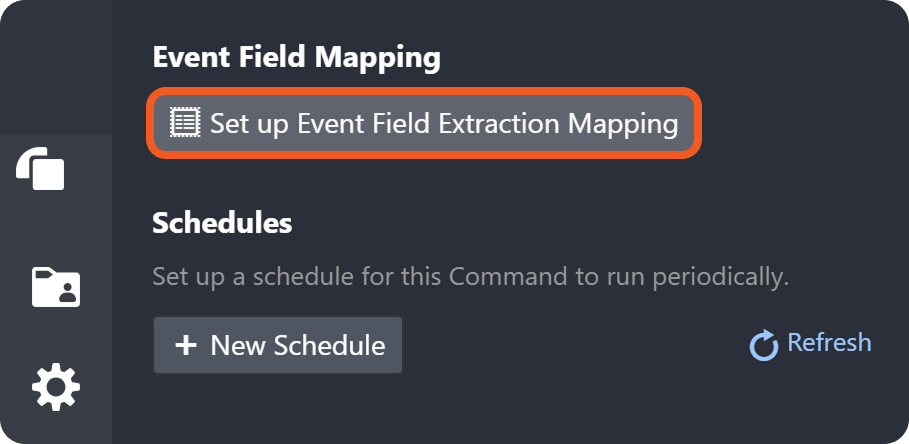
Click on the Set Up Event Field Extraction Mapping button.
-
Note the Main Event JSONPath expression (i.e., root context).
-20250630-175827.png?cb=b9a141df8c3a60d7dd7de1c322712e22)
-
Select the Event Source for Organization option within the dropdown, then add a new field with the following source field value:
.demo_key.layer2.layer3.layer4.layer5.target-20250630-183105.png?cb=03c99a80df7cd453822937f78fb9b89a)
-
Enable webhook authentication, then select the API Key option.
-20250630-183146.png?cb=2030a7ca022f42f4df3cd2e0c4393d70)
READER NOTE *
-
Create an API key.
-20250630-185629.png?cb=76c791e88f34a5869a5a9636e5e6abed)
-
Copy the request information to Postman, then select a preprocessing playbook under the Additional Settings accordion.
-20250630-185035.png?cb=d61a359bc4ca2207a7248e1b85ad6aae)
-
Send the POST request on Postman.
-20250630-190041.png?cb=f3a1bc6da16b2ffb69148285efb6180b)
-
Verify that an event was created in the Data Ingestion module.
-20250630-190128.png?cb=1a35db952b49ff74b049a9a904823031)
-
Note the eventId number.
-20250630-190217.png?cb=f2a5cef8c7a3ce1788dd341b1c476123)
-
Navigate to the Investigation Dashboard page.
-20250630-190451.png?cb=0a89e5049580ce0c292fa23d0bdcac88)
-
Select the site in which the API key was generated in step 6.
-20250630-190521.png?cb=0b03daca767102b58de5dbc6444ca4ae)
-
Locate the event with an ID matching the one observed in step 10, then click on the event to view its details.
-20250630-190816.png?cb=ec5b5bf4b9cfa44ba89894d130088ada)
-
Verify that the value extraction for the "target" field is displayed adjacent to the custom field configured in step 4.
-20250630-191349.png?cb=2a697870c472f462b177222581adaaae)
Example 2 - Bracket Notation
Objective – Demonstrate the use of bracket notation to extract the "target" field from the ingested JSON payload.
-
Navigate to the Fetch Event command of the Zendesk integration.
-
Click on the Set Up Event Field Extraction Mapping button.
-
Note the Main Event JSONPath expression (i.e., root context).
-
Select the Event Source for Organization option within the dropdown, then add a new field with the following source field value:
['demo_key']['layer2']['layer3']['layer4']['layer5']['target']-20250630-192514.png?cb=3cac40118114420486714d91db727206)
-
Enable webhook authentication, then select the API Key option.
READER NOTE *
-
Create an API key.
-
Copy the request information to Postman, then select a preprocessing playbook under the Additional Settings accordion.
-
Send the POST request on Postman.
-
Verify that an event was created in the Data Ingestion module.
-20250630-193013.png?cb=044d82f9612c987123c14c1327c7f339)
-
Note the eventId number.
-20250630-193616.png?cb=6c081bea22c1028e27440d89c3975485)
-
Navigate to the Investigation Dashboard page.
-
Select the site in which the API key was generated in step 6.
-
Locate the event with an ID matching the one observed in step 10, then click on the event to view its details.
-20250630-193905.png?cb=ca0040ffcdd8e39375f9cb0c8122c08e)
-
Verify that the value extraction for the "target" field is displayed adjacent to the custom field configured in step 4.
-20250630-194123.png?cb=367f1f176e4857c9e72151b1014baa13)
Example 3 - Mixed Dot and Bracket Notation
Objective – Demonstrate the mix use of dot and bracket notation to extract the "target" field from the ingested JSON payload.
-
Navigate to the Fetch Event command of the Zendesk integration.
-
Click on the Set Up Event Field Extraction Mapping button.
-
Note the Main Event JSONPath expression (i.e., root context).
-
Select the Event Source for Organization option within the dropdown, then add a new field with any of the following sample source field values:
sample 1.demo_key.layer2['layer3']['layer4'].layer5['target']sample 2
['demo_key'].layer2.layer3['layer4']['layer5'].targetsample 3
.demo_key['layer2'].layer3['layer4'].layer5['target']-20250630-195443.png?cb=279a0e86764f9097a747b02199375462)
-
Enable webhook authentication, then select the API Key option.
READER NOTE *
-
Create an API key.
-
Copy the request information to Postman, then select a preprocessing playbook under the Additional Settings accordion.
-
Send the POST request on Postman.
-
Verify that an event was created in the Data Ingestion module.
-20250630-195944.png?cb=c9693cf27c8dc1b3dc4b99b5bc8c763e)
-
Note the eventId number.
-20250630-200016.png?cb=1383ae94bee6ae0ec3d6d4b3e1fa017a)
-
Navigate to the Investigation Dashboard page.
-
Select the site in which the API key was generated in step 6.
-
Locate the event with an ID matching the one observed in step 10, then click on the event to view its details.
-20250630-200157.png?cb=d6d913eec7fb0ce24a447af16b28440b)
-
Verify that the value extraction for the "target" field is displayed adjacent to the custom field configured in step 4.
-20250630-200333.png?cb=c7148da5b57140c74a008370f9c74d9d)
Example 4 - Recursive Descent
Objective – Demonstrate the use of recursive descent to extract the "target" field from the ingested JSON payload.
-
Navigate to the Fetch Event command of the Zendesk integration.
-
Click on the Set Up Event Field Extraction Mapping button.
-
Note the Main Event JSONPath expression (i.e., root context).
-
Select the Event Source for Organization option within the dropdown, then add a new field with any of the following sample source field values:
sample 1..targetsample 2
..layer5.targetsample 3
.demo_key..targetsample 4
..layer2..target-20250630-223922.png?cb=6aac7f23de077801bb50f254035980d1)
-
Enable webhook authentication, then select the API Key option.
READER NOTE *
-
Create an API key.
-
Copy the request information to Postman, then select a preprocessing playbook under the Additional Settings accordion.
-
Send the POST request on Postman.
-
Verify that an event was created in the Data Ingestion module.
-20250630-224303.png?cb=3a7ea580f8ce0f9bf4b5cfa5393948f1)
-
Note the eventId number.
-20250630-224606.png?cb=cbf531830900044a109e6bad03823971)
-
Navigate to the Investigation Dashboard page.
-
Select the site in which the API key was generated in step 6.
-
Locate the event with an ID matching the one observed in step 10, then click on the event to view its details.
-20250630-224740.png?cb=176b1049677c390d0b94e71565503969)
-
Verify that the value extraction for the "target" field is displayed adjacent to the custom field configured in step 4.
-20250630-225037.png?cb=1c5a5508cd1e7f6d0828c3df38bb80c3)
Example 5 - Filter Expression
Objective – Demonstrate the use of various filter expressions to extract the "target" field from the ingested JSON payload.
EXPRESSION RESTRICTION
Fields above the level of the filtered array item cannot be retrieved.
invalid EXAMPLES
🚫 ..[?(@.target == 'value A2')].name
🚫 ..[?(@.target == 'value A2')].notes
🚫 ..[?(@.target == 'value A2')].group_id
-
Navigate to the Fetch Event command of the Zendesk integration.
-
Click on the Set Up Event Field Extraction Mapping button.
-
Note the Main Event JSONPath expression (i.e., root context).
-
Select the Event Source for Organization option within the dropdown, then add seven fields with the following source field values:
Demo field 1 (returns an object)..[?(@.target == 'demo value 133')]demo field 2
..[?(@.target == 'demo value 133')].targetdemo field 3 (returns an object with nested objects)
..[?(@['layer4'].layer5['target'] == 'demo value 133')]Demo Field 4
..[?(@.shared_tickets==false)].demo_key.layer2.layer3.layer4.layer5.targetDemo Field 5
..[?(@.tags[?(@=='tag 133')])]..targetDemo Field 6
..[?(@organization_fields.country=='canada')]..targetDemo Field 7 (returns an object)
..[?(@.organization_fields.country!='usa')]..[?(@.target=='demo value 133')]DEMO FIELD 8
..[?(@.group_id >= 100 && @.group_id < 200)]..target-20250702-201746.png?cb=00b16c012ef49e1bbcd52dba6468670f)
-
Enable webhook authentication, then select the API Key option.
READER NOTE *
-
Create an API key.
-
Copy the request information to Postman, then select a preprocessing playbook under the Additional Settings accordion.
-
Send the POST request on Postman.
-
Verify that an event was created in the Data Ingestion module.
-20250702-202547.png)
-
Note the eventId number.
-20250702-202455.png?cb=195c7b6c24e4170c6664f670defbce5c)
-
Navigate to the Investigation Dashboard page.
-
Select the site in which the API key was generated in step 6.
-
Locate the event with an ID matching the one observed in step 10, then click on the event to view its details.
-20250702-202717.png?cb=cd8b52bfd91793359ed0d8590d8df51e)
-
Verify that the value extraction for the "target" field is displayed adjacent to the custom field configured in step 4.
-20250702-202858.png?cb=28ec80eb370e421627eff327f4f3b310)
FAQ
Where can users configure the Main (Event) JSONPath expression?
The Main Event JSON Path, configured in (Default Event Source) > Edit Event Source, defines the root context from which individual EFM source fields are resolved.
-20250627-203139.png?cb=b9a141df8c3a60d7dd7de1c322712e22)
The Main JSON Path is configured at the top of the IFM interface.
-20250729-184403.png?cb=b6b6e8050fc23ef8c0659f300bf661b6)
What does extracting targets at every depth using recursive descent mean?
Sample Ingested Data
{
    "results": [
        {
            "id": 74,
            "result_type": "organization",
            "name": "org A",
            "demo_key": {
                "layer2": {
                    "target": "value A1",
                    "layer3": {
                        "layer4": {
                            "target": "value A2"
                        }
                    }
                }
            }
        }
    ]
}
Using the source field ..target
%201-20250702-234542.png?cb=55aec562d5187a1252ac8d50eb756b42)
the output will be:
value A1, value A2
-20250702-233918.png?cb=8d0cf0c2790e788db512bfc383019efa)
READER NOTE
JSON does not permit duplicate field names within the same level of an object.
Example – Consider the sample ingested data modified to the following structure:
{
  ...
  "layer2": {
    "target": "value A1",
    "target": "value A2"
  }
  ...
}
In this case, if ..target was used as the source field path, the second "target" key will overwrite the first during parsing.